

How to Transition Into Auto Sales Management in 2026
Overview
Introduction: Driving Your Career Forward in Auto Sales Management
You have been selling cars for a while now. You know the lot. You know the customers. You have hit your numbers month after month. But lately, you have been thinking about something bigger. You want to lead a team. You want to shape the strategy. You want to move into auto sales management.
That shift from salesperson to manager is exciting. But it can also feel a little unclear. You know how to close a deal. You are not so sure about the sales management duties like tracking inventory, coaching your team, or reporting on key performance data. According to a detailed job breakdown from Auto Jobs, a sales manager handles everything from acquiring new vehicle inventory to monitoring factory sponsored programs.
That is a big jump from just selling cars on the lot.
Many sales professionals face this same uncertainty. You are great at your current sales job. You just need a clear path forward into a sales management job.
Here is the good news. Auto sales management offers a career path that blends your sales skills with real leadership and business strategy. It is a chance to earn more, grow more, and have a bigger impact on the dealership.
This guide gives you a structured roadmap for making that move. We cover the skills you need, the steps to take, and the industry trends shaping 2026. If you are aiming higher in your career or even exploring remote sales jobs later on, knowing the ins and outs of management is your next smart step. For more on building your leadership path, take a look at the 2026 career blueprint for management rights and sales success.
Let us get you behind the wheel of your future.

What Does an Auto Sales Manager Actually Do?
So, you are eyeing that office with the glass walls. You see the sales manager every day. They talk to the team. They check boards. They step into meetings. But what do they actually do all day?
The short answer is: a lot. An auto sales management role is not just about selling cars anymore. It is about running a small business inside a bigger one.
**You wear many hats every day.

**
First, you oversee daily sales operations. This means you watch the floor.

You help salespeople when they struggle. You make sure customers feel happy from the moment they walk in. Your goal is to keep the sales process moving smoothly from start to finish.
Second, you handle inventory strategy. A big part of your sales management duties involves deciding which cars to order and when. According to a detailed job description from Auto Jobs, you are responsible for ordering new and used vehicles and running factory sponsored programs. You must know what sells in your market. You decide which models to display and how to price them to move fast.
Third, you track team performance. You watch key numbers like closing rate and average profit per car. You must report these numbers up to the general manager. A breakdown of the car sales manager role confirms that tracking and reporting key sales metrics is a core part of the job.
You balance leadership with financial targets.
You cannot just watch numbers. You also lead people. You motivate the team. You coach underperforming reps. You celebrate wins. It is a balance between being a coach and a boss.
You work very closely with the finance and insurance department to make sure deals get funded and delivered smoothly. One of your primary responsibilities is to build strategies that hit revenue targets, as highlighted in this overview of the automotive sales manager role. You are the link between the sales floor and the general manager’s office.
The job is changing fast in 2026.
Here is the thing. The role is not what it was five years ago. More customers start their buying journey online. They expect virtual walkarounds and digital paperwork.
This means a modern sales manager must understand digital tools. You might manage remote sales reps who work from home part of the time. You need to be comfortable with your dealership’s CRM software to track leads and analyze data. The industry is shifting, and the 2026 outlook from PwC shows changes in consumer behavior and inventory management that managers must navigate.
If you are curious about how this digital shift opens doors for different career paths, you might also want to explore opportunities in remote sales jobs.
Also, you need to keep up with new selling techniques. Learning how to use technology to attract online buyers can give you a real edge. That is where mastering AI digital marketing becomes a powerful skill for any modern sales leader.
So, the auto sales management job is a mix of old-school leadership and modern business strategy. It is demanding. But it is also one of the most rewarding career moves you can make in the automotive world.
Essential Skills and Competencies for Auto Sales Management
You now know what the job looks like from the outside. But to really succeed in auto sales management, you need a specific set of skills. Some you can learn in a classroom. Others you only build through experience.
Let’s look at what matters most in 2026.
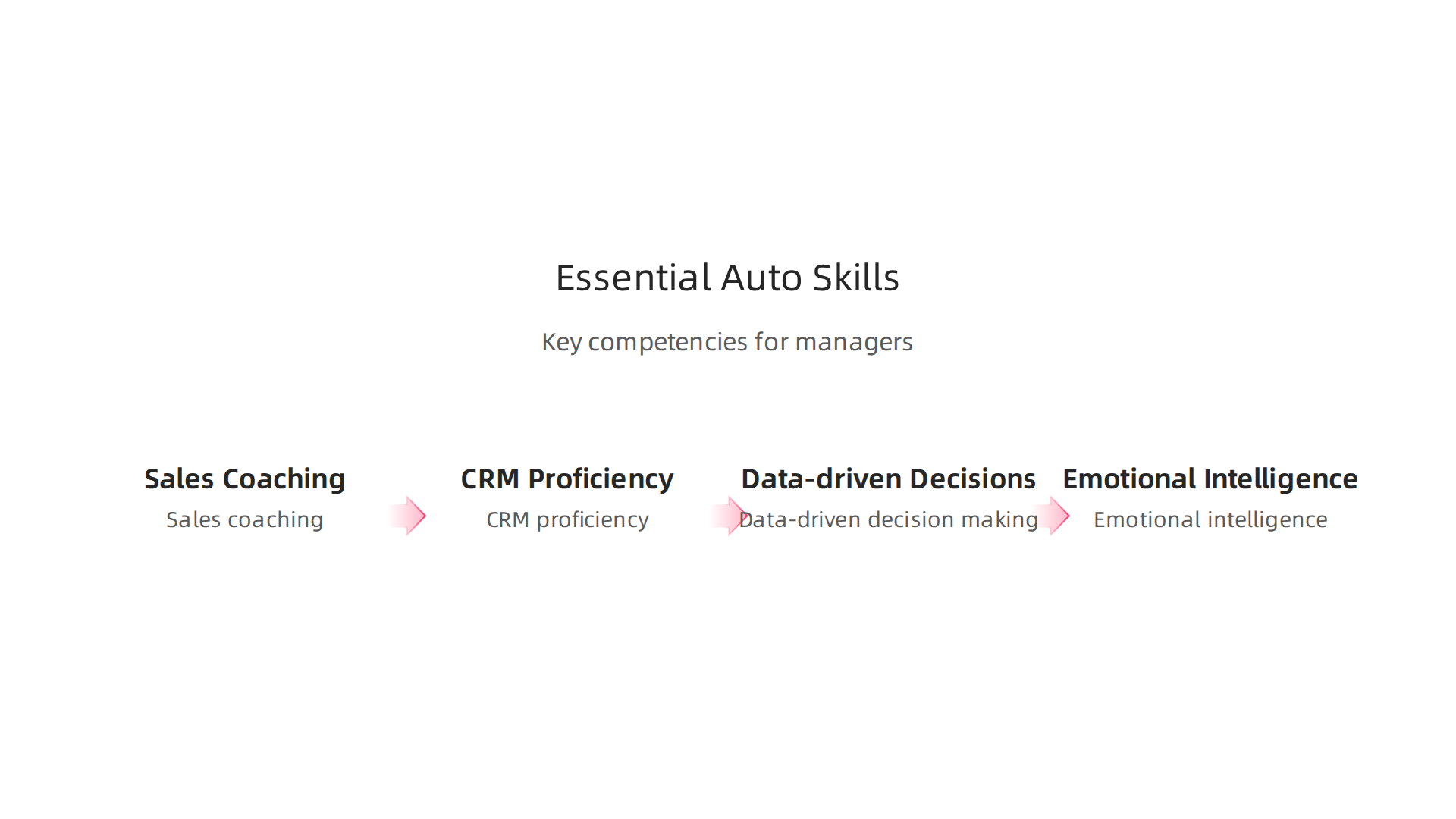
Sales coaching and team leadership come first.
You cannot just point at a board and yell. That does not work anymore. A strong sales management job requires you to coach your team every single day.
You need to walk the floor. You need to listen to how your reps talk to customers. You need to point out what they did well and where they can improve. According to Proactive Training Solutions, effective managers focus on building high performing teams through continuous coaching.

Your job is to make everyone around you better.
CRM proficiency is non-negotiable.
Everything in a modern dealership runs on data. You need to know your customer relationship management software better than anyone on your team.
You track leads. You see which reps follow up. You analyze where the deals are coming from. If you want to move into advanced leadership roles, mastering these digital tools is a huge advantage. It is similar to what we cover in our guide to mastering AI digital marketing for online sales jobs.
Negotiation and deal structuring are timeless.
You will still sit in the tower when a tough customer walks in. You need to know how to structure the payment, handle the trade in, and maximize profit without losing the deal.
This skill takes practice. But a manager who can close the hard deals earns instant respect from their sales team.
Data driven decision making separates good from great.
Your gut matters. But the numbers matter more in 2026.
You need to track closing ratios, gross profit per car, and customer satisfaction scores. You use this data to find weak spots. Maybe one rep struggles with test drives. Maybe another needs help with follow up calls. The data tells you exactly where to focus.
Emotional intelligence and adaptability are essential soft skills.
Here is the thing. The industry is changing fast. Customers do their research online. They walk in knowing more than some salespeople.
You need high emotional intelligence to read every situation. You need to motivate a rep having a bad day. You need to adapt your strategy when the market shifts. This is a skill you cannot fake. And it is one of the biggest reasons managers fail or succeed.
Formal training and certification give you an edge.
You do not have to figure this out alone. There are excellent programs built just for auto sales management.
The NADA Sales Management program is the gold standard in the industry. It covers department operations, leadership, and legal compliance. The program fee is about $2,995. It gives you a certification that looks great on any resume.
Other programs like Product Prep offer specialized automotive sales certifications. These help you build foundational knowledge fast.
According to Selling Power, the best training in 2026 must be reinforced over time. It is not a one time event. You need to keep learning to stay ahead.
If you are looking to move up into senior roles, understanding the full path is helpful. You might want to check out our definitive roadmap to becoming a sales director in 2026.
The bottom line is simple. Auto sales management requires a mix of hard skills, soft skills, and formal training.
Build all three. And you will have a long, rewarding career.
Career Path: From Sales Consultant to General Manager
You now know the skills you need for an auto sales management job. But how do you actually get there? The path is clearer than you might think.
Most dealership leaders start right where you probably are. They begin as a sales consultant on the showroom floor.
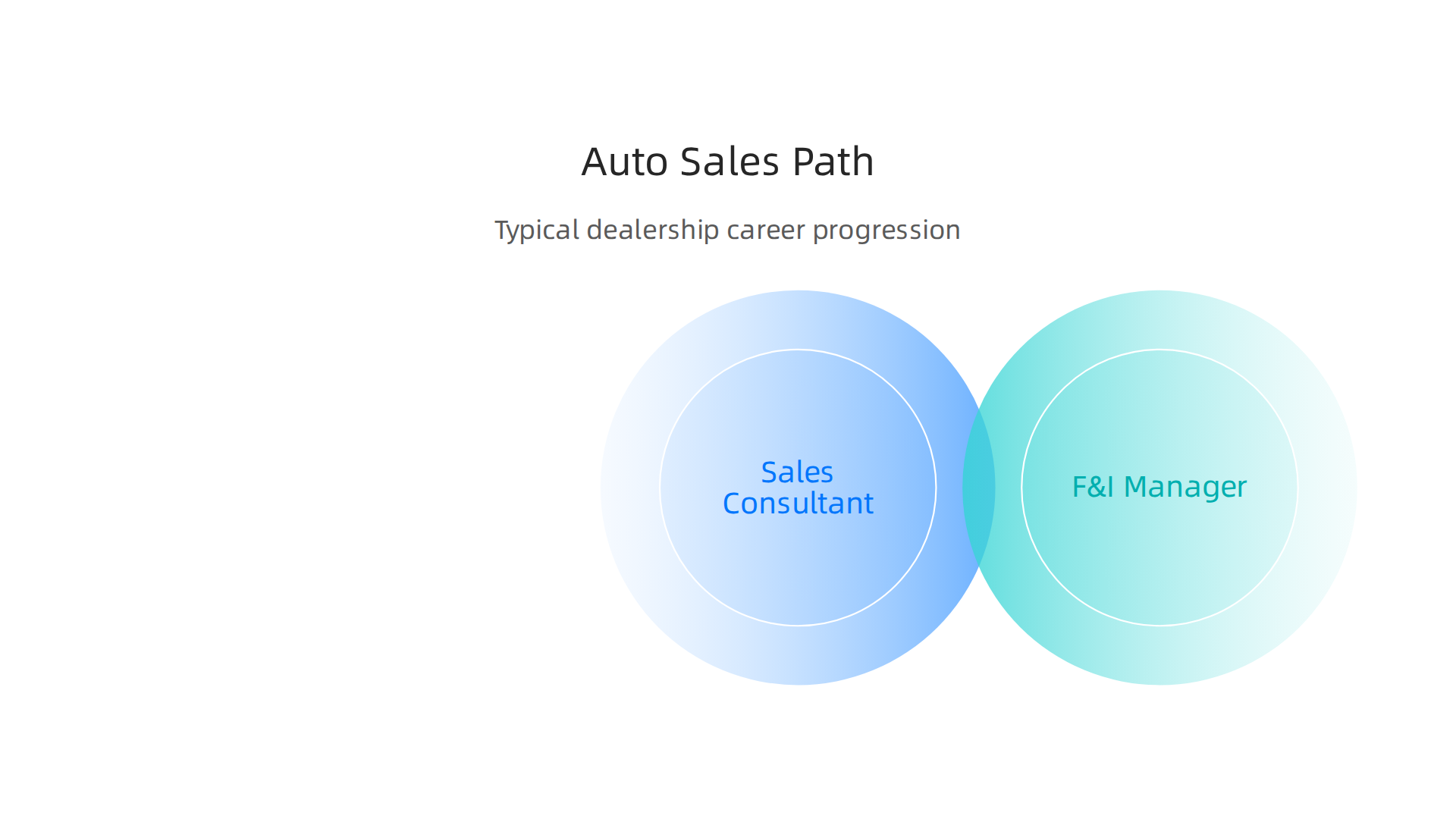
The typical progression looks like this:
Sales Consultant → (F&I Manager or Desk Manager) → Sales Manager → General Manager
It takes time. It takes results. But every step builds on the one before it.
Step 1: Sales Consultant
You learn the basics. You handle walk ins and phone ups. You learn to qualify customers, present vehicles, and close deals. You also learn what not to do.
The best future managers are the ones who sell a lot of cars while also helping their teammates. They lead by example.
Step 2: Intermediate Roles
Before you become a sales manager, most dealerships want you to prove yourself in a specialized role.
F&I Manager (Finance and Insurance) – You handle the paperwork after the sale. You sell warranties, gap insurance, and loan packages. This role teaches you deal structure and compliance. It is a common stepping stone.
Desk Manager – You work behind the scenes. You help sales consultants structure deals. You negotiate trade ins. You manage the numbers. This role is all about profit management.
Both roles build the operational knowledge you need for a sales management job.
Step 3: Sales Manager
At this point you are in charge of the sales floor. Your job is coaching, tracking, and closing. You manage a team. You hit monthly targets. You report to the general manager.
Your sales management duties now include hiring, training, and firing. You set the schedule. You run the meetings. You handle customer complaints.
And the pay is serious. According to PayScale, the average automotive sales manager salary in 2026 is around $86,000 per year. But that number varies by location and dealership. On the higher end, Salary.com reports $140,384 for an Automobile Sales Manager. Glassdoor shows roughly $111,000 to $124,000. Your actual income depends on performance.
Step 4: General Manager
This is the top of the store. You run everything. Sales, service, parts, and finance all report to you. You answer only to the dealer owner or a regional group.
Getting here requires years of proven leadership and operational skill.
Barriers along the way
The path is not automatic. Two big things hold people back.
First, a lack of formal training. Many managers learn on the job. But those who take structured programs move faster. The skills section covered that.
Second, competition. Good dealerships have plenty of internal candidates. You need to stand out. Networking helps. So does mentorship. Find a senior manager who will teach you the business side.
If you want to map out the full journey to the corner office, read our definitive roadmap to becoming a sales director in 2026. It covers the exact steps from middle management to executive leadership.
The bottom line
Every general manager started somewhere. Most started on the sales floor. If you are willing to learn, work hard, and keep growing, you can make it too.
The salary data proves one thing. Auto sales management pays well. And the path is open to anyone who earns it.
Compensation, Benefits, and Income Potential
So what does all this mean for your bank account? Auto sales management pay is not a single number. It changes based on where you work, who you work for, and how well your team performs. But one thing is clear. The earning potential is serious.
How Auto Sales Managers Get Paid
Most dealerships use a mix of base salary plus commission. Your base covers your basic income. The commission is where the real money comes from. You earn a percentage of your team’s sales or the gross profit they generate. This means your paycheck goes up when your team performs well.
According to PayScale, the average base salary for a sales manager in 2026 is around $86,080. But that is just the starting point. Salary.com reports the top end at $140,384. Glassdoor shows an average total pay of $111,225 for automotive sales managers and $123,975 for auto sales managers specifically. The range is wide.
Benefits That Add Up Fast
Cash is not the only reward. Most dealerships offer a full benefits package:
- Monthly or quarterly bonuses for hitting targets
- Vehicle allowances so you drive a new car every year
- Profit sharing when the dealership does well
- Health insurance, retirement plans, and paid time off
These extras can add thousands to your total compensation. A good vehicle allowance alone is worth $6,000 to $12,000 per year.
The Big Variable: Performance and Location
Here is the thing. Your actual income depends on three factors.
First, dealership size and brand. Luxury brands like BMW or Mercedes pay more. High volume stores also pay more because the gross profit is bigger.
Second, location. Managers in big cities earn more. A manager in New York or Los Angeles makes more than one in a small town. But the cost of living is higher too.
Third, your team’s performance. If your sales team hits their numbers every month, you look like a hero and your commission reflects that. If they struggle, your income drops. That uncertainty can be stressful.
Income Uncertainty Is Real
This is the main pain point. Your paycheck can change month to month. One month you might earn $12,000. The next month you might earn $7,000. You have to plan for that.
If you prefer more predictable income, you might consider a different path. For example, there are legitimate remote sales jobs that offer a stable base and commission structure. You can check out our guide to uncover legitimate remote sales jobs with direct sales agencies to see if that fits your lifestyle better.
The Bottom Line on Auto Sales Management Income
The numbers speak for themselves. Auto sales management pays well. The average sales management job in this field lands between $86,000 and $140,000 per year when you include bonuses. The sales management duties come with pressure, but the financial reward is real.
Now that you know what you can earn, the next step is putting together your application. Ready to learn how to stand out? Keep reading.
Overcoming Key Challenges in Auto Sales Management
You land the job. You lead your team. Then reality hits. Auto sales management is rewarding, but it comes with real hurdles. The good news is you can overcome them with the right approach.
Let’s look at the biggest challenges and how to handle them.
High Staff Turnover
One of the hardest parts of a sales management job is keeping good people. Turnover is high in car sales. According to a recent look at common sales manager challenges, recruiting top sales professionals and managing the next generation of sellers like Gen Z is a top concern for 2026.
How do you fight this? Use structured training. Do not just throw new hires onto the lot. Give them a real onboarding plan. Show them how to use your CRM. Teach them your sales process step by step. When salespeople feel supported, they stay longer. That makes your sales management duties easier.
Managing Remote and Hybrid Teams
Not all sales happen inside the dealership anymore. Many customers start their journey online. Some of your team may even work from home some days. This creates a new challenge.
Leading a remote or hybrid sales team requires a different skill set. You cannot just walk by their desk to check in. You need clear expectations and regular communication. A practical playbook for managing distributed sales teams suggests setting clear goals, balancing real-time meetings with async work, and coaching with data.
Transparency is key. Use video calls for team huddles. Track performance with CRM reports. Make sure every person knows what they need to do. Data driven reviews help you catch problems early and celebrate wins.
Adapting to Digital Sales Tools
The old days of just shaking hands and making a deal are gone. Now you need digital tools. Online quoting, video walkarounds, and electronic signatures are standard. If you cannot adapt, you will fall behind.
Learn the tech yourself first. Then train your team. Make using these tools part of your daily routine. This shift from in-person to online selling requires new skills like virtual closing and CRM management. You can also master AI digital marketing to stay ahead. It is one of the smartest moves for your sales management duties in 2026.
The Constant Pressure to Hit Targets
Every month the meter resets. You need to hit your numbers. If you do not, the stress builds fast.
The key is turning strategic plans into daily results. You cannot just set a big goal for the quarter. You need to break it down. What do you need to sell this week? This day? This hour?
Make tough decisions early. Prioritize the most critical tasks. Then execute consistently. That is how you turn pressure into performance.
Your Path Forward
These challenges are real, but they are not deal breakers. Every great sales manager faces them. The ones who succeed are the ones who prepare.
If you are serious about moving into this role or advancing your career, building these skills early gives you a huge advantage. For a deeper look at climbing the ladder, check out the definitive roadmap to becoming a sales director. It shows you the exact steps to take.
Future Trends: Technology, Electric Vehicles, and Digital Retail
What will auto sales management look like in five years? The answer is already taking shape. 2026 is a big year for change. If you want to stay ahead, you need to know what is coming.
Let’s break down the three biggest trends you can expect.
The Electric Vehicle Shift
EVs are not a distant future anymore. They are here now.

Experts predict that EVs, including battery-electric and plug-in hybrid vehicles, could make up nearly a quarter of all new car sales in 2026. That is a huge shift from just a few years ago.
This changes how you manage your team. Your salespeople need to know how to explain battery range, charging options, and tax credits. They need to answer questions customers have never asked before. Direct-to-consumer models from some EV brands also challenge the traditional dealership model. That means your sales management duties now include navigating new legal and regulatory trends in auto distribution.
Smarter Digital Retail Tools
The days of paper forms and waiting for approvals are ending. Automotive retail in 2026 runs on smarter systems. AI-powered CRMs help your team prioritize leads and predict which customers are ready to buy. Online financing tools let customers get approved before they step on the lot. Virtual showrooms let shoppers browse inventory from their living room.
For you as a sales manager, this means upskilling your team. You cannot just teach product knowledge anymore. You must train them on digital tools like e-signature platforms, video walkarounds, and CRM workflows. These tools boost efficiency and profitability when used right.
Remote Sales Management Opportunities
Here is a trend you might not expect. The rise of online sales means some dealerships now hire remote sales managers. Yes, really. You can oversee a team from a different city or even state.
This opens the door for talented managers who do not live near a major dealership. It also requires new skills. You need to run virtual meetings, track performance through CRM reports, and coach from a distance. That is a big change from the old days of walking the lot. But it also means more flexibility and a wider range of sales jobs to choose from.
Your Next Step
These trends are not scary. They are opportunities. The managers who learn to embrace EVs, master digital tools, and lead remote teams will have the best careers in 2026 and beyond.
Start by building your own tech skills. Learn the CRM your dealership uses. Watch a video on AI in auto retail. Get comfortable with the tools. Then teach your team.
For a complete look at climbing the ladder with these skills, check out the definitive roadmap to becoming a sales director. It shows you exactly what to learn next.
Summary
This guide walks experienced car salespeople through the practical move into auto sales management, explaining what managers actually do, which skills matter in 2026, and how the role has changed with digital retail and electric vehicles. You’ll learn the day-to-day duties—from inventory strategy and coaching to CRM reporting—the concrete skill set employers want (coaching, negotiation, data-driven decision making, and CRM proficiency), and which formal programs can accelerate your promotion. The article maps the usual career ladder (sales consultant → desk/F&I roles → sales manager → general manager), outlines typical compensation structures and ranges, and highlights common pitfalls like turnover, remote team management, and income variability. It also previews future trends and gives actionable steps to prepare your team and your resume so you can make the jump into management with confidence.